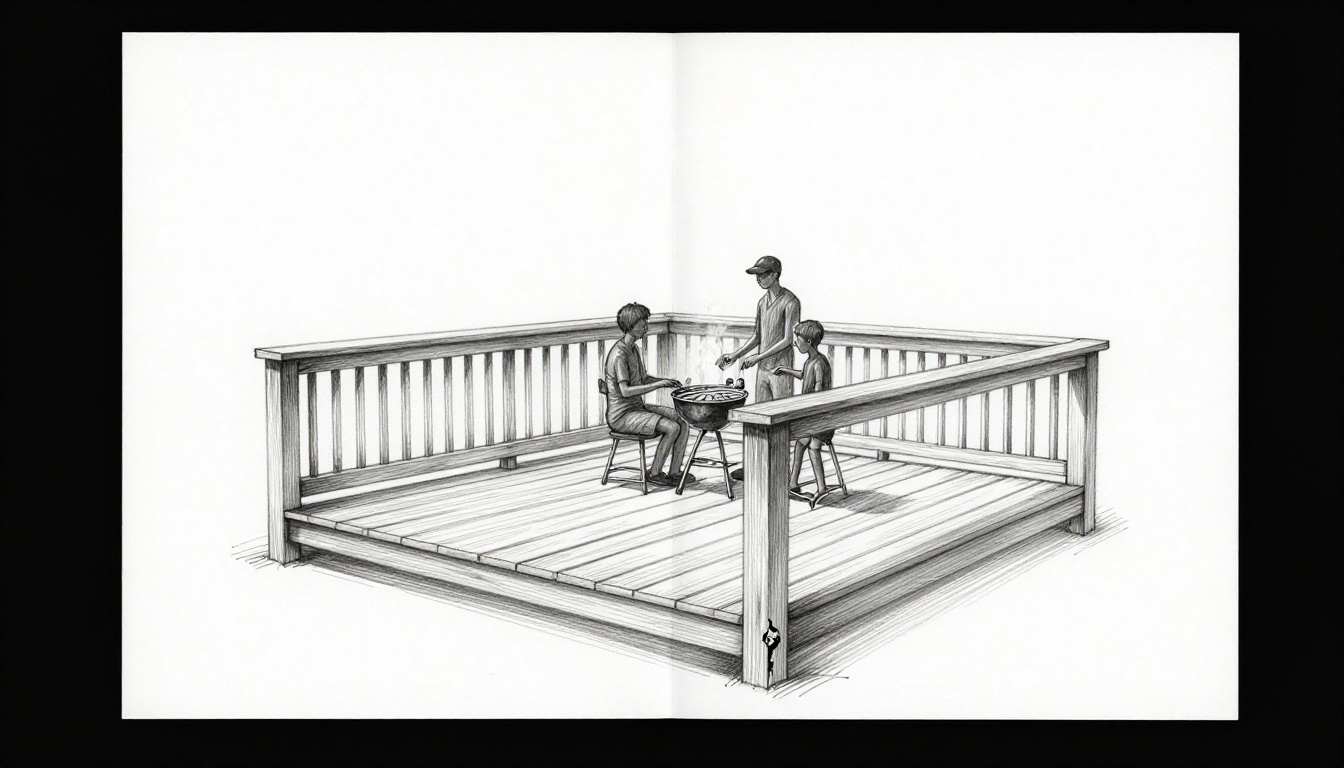
Picture this: a family gathers on a backyard deck for a summer barbecue. Laughter fills the air until a sharp crack echoes. The deck sags, posts buckle under the weight, and everyone scrambles to safety. That near-disaster happened because someone skipped calculating the load-bearing capacity for deck posts.
Load-bearing capacity means the maximum weight each post can safely hold without failing. Homeowners must get this right to prevent collapses, meet building codes, and keep families safe. Weak posts lead to injuries or total rebuilds. Codes demand precise math based on your area’s snow, wind, and soil.
This guide walks you through every step. You’ll learn what loads posts face, factors that affect strength, and exact calculations with examples. By the end, you’ll calculate with confidence and build a deck that lasts.
What Loads Are Your Deck Posts Actually Supporting?
Deck posts carry two main types of weight: dead loads and live loads. Dead loads stay constant, like the deck’s own materials. Live loads change, such as people dancing or winter snow piling up. Each post supports a portion of the total, called the tributary area.
Building codes set standard values. The International Residential Code (IRC) Table R507.5 lists 40 psf live load and 10 psf dead load for most decks. Psf means pounds per square foot. However, your location matters. Snowy areas bump live loads to 60 psf or more. Wind adds lateral force too.
Take a 12×12 deck, or 144 square feet. Divide by four corner posts, and each handles about 36 square feet. But posts in the middle carry more if beams span between them. First, map your layout.
Dead Load vs. Live Load: Spot the Difference
Dead load includes permanent parts. Wood decking weighs about 3 psf. Joists and beams add another 5 psf. Railings and a hot tub push it to 10 psf total. For 200 square feet, that’s 2,000 pounds spread across posts.
Live load varies. Five adults at 80 pounds each equal 400 pounds. Furniture adds 200 more. In snow country, 50 psf means 10,000 pounds on that same deck. Always add dead and live for total psf. Codes require this combined check for safety.
Combine them wrong, and posts fail fast. A 10×20 deck might need posts rated for 8,000 pounds each. Ignore snow, and you’re asking for trouble.
Tributary Area: The Key to Per-Post Load Sharing
Tributary area is the deck section each post supports. Measure joist span from post to post, then beam span. Multiply those for square footage per post.
For example, joists span 8 feet between beams. Beams span 10 feet between posts. One post’s tributary area equals 8 x 10, or 80 square feet. Edge posts get half that, around 40 square feet, because they share with the house.
Multiply tributary by total psf. At 50 psf, that post carries 4,000 pounds. Sketch your deck on paper. Label spans. This step prevents overload surprises.
Key Factors That Boost or Limit Post Strength
Post strength depends on material, size, grade, height, bracing, and footings. Pressure-treated southern pine works best outdoors. A 6×6 post beats a 4×4 every time. Higher grades like #1 resist defects better than #2.
Height weakens posts through buckling. An 8-foot post holds less than a 6-foot one. Bracing adds stability. Footings must reach below frost line and match soil strength. IRC Table R507.4 gives span limits based on these.
Choose wisely, and your posts last decades. Pick wrong, and they snap under normal use.
Choosing the Right Size, Material, and Grade
Size matters most. A 4×4 post, 8 feet tall, handles up to 10,000 pounds in compression. Switch to 6×6, and it jumps to 18,000 pounds. Southern pine #2 grade offers 1,150 psi allowable stress parallel to grain.
Cedar looks nice but holds less, around 800 psi. Steel posts shine in tight spots but cost more. Check actual cross-section area: 4×4 is 3.5×3.5 inches, or 12.25 square inches.
Here’s a quick comparison for 8-foot posts:
| Post Type | Size | Allowable Load (lbs) | Best For |
|---|---|---|---|
| Southern Pine #2 | 4×4 | 10,000 | Small decks |
| Southern Pine #2 | 6×6 | 18,000 | Standard decks |
| Cedar #2 | 6×6 | 12,000 | Appearance focus |
This table shows why bigger wins. Multiply stress by area for custom checks.
How Height, Bracing, and Footings Play a Role
Taller posts buckle easier. The formula simplifies to slenderness ratio: height divided by least dimension. Over 11, strength drops fast. Brace with knee walls or cables.
Footings bear the post load into soil. Dig 42 inches deep in cold climates. Use 12-inch diameter concrete for 4x4s, 18-inch for 6x6s. Soil holds 1,500 to 3,000 psf typically. Weak clay needs bigger bases.
Poor footings shift and crack posts. Solid ones lock everything firm.
Simple Steps to Calculate Your Deck Post Capacity
Start with required capacity: tributary area times total psf. Compare to allowable from tables. Add a safety factor of 1.5 to 2. Most posts exceed needs easily if sized right.
Grab paper, measure tape, and code book. Follow these steps for any deck.
Step 1: Measure Your Deck Layout and Loads
Draw beams and joists. Note spans. Calculate tributary: joist span times beam span, halved for edges.
Look up local loads. Ground snow map gives psf. Add 10 psf dead. A 10×12 deck (120 sq ft) with four posts has 30 sq ft tributary each. At 50 psf total, required load is 1,500 pounds per post.
Step 2: Pick Post Specs and Find Allowable Loads
Select 6×6 southern pine #2, 8 feet high. IRC or AWC tables list 12,000 pounds axial capacity.
Online span calculators confirm. Factor in height and bracing for adjustments.
Step 3: Crunch the Numbers and Compare
For that 10×12: 30 sq ft x 50 psf = 1,500 pounds needed. Post allows 12,000. Plenty safe.
If tributary hits 100 sq ft at 60 psf, that’s 6,000 pounds. Still under, but add posts if close. Exceeds? Upsize to 6×6 or shorten spans.
Avoid These Pitfalls and Verify for Peace of Mind
Common errors sink decks. Forgetting snow loads halves capacity. Low-grade wood cracks early. Skip bracing on tall posts, and they sway. Shallow footings heave in freezes.
Build in a 20% buffer. Use free software like the Deck Tools app for double-checks. Permits force code review anyway.
Irregular shapes or high-wind zones need engineers. Don’t risk it.
Quick Checks Before You Build
Inspect wood for knots or splits. Test footings with a probe for soil firmness. Simulate load: stack sandbags equal to tributary weight. Watch for flex.
Pull permits early. Inspectors catch mistakes. These steps save headaches.
Calculating load-bearing capacity keeps your deck solid. Follow the steps: map loads and tributary, pick strong posts, crunch numbers. Always check local codes for exact psf.
Build safe. Share your calculations in the comments. Did this help your project? Pin it for reference.
Safety comes first. Consult a pro for doubts. Your family deserves a deck that stands strong.